Consulting • Strategy • GCC
GCC Strategy • Business Consulting • 2026

GCC Consulting Services in India: The AI-Native Playbook for Scalable Capability Centres in 2026

India's Global Capability Centre landscape is moving beyond cost-focused delivery. Discover how a structured business-consulting approach can align strategy, operating models, talent, governance and ecosystem partnerships for the next generation of AI-native GCCs.

By Tracon Ventures 12-minute read Category: GCC Consulting
AI-native GCC consulting services in India by Tracon Ventures
From delivery centre to enterprise intelligence engine: the new GCC mandate combines strategy, capability and responsible execution.

GCC consulting services in India are entering a new phase. Global organisations are no longer evaluating India only as a location for lower-cost delivery. They are asking a more strategic question: how can an India-based Global Capability Centre become a source of product innovation, enterprise intelligence, resilience and faster decision-making?

The answer requires more than selecting an office, hiring a team or introducing a collection of AI tools. A future-ready GCC needs a clear business mandate, the right capability portfolio, an accountable operating model, disciplined governance and an ecosystem that can support scale. This is where a business consultant can help leadership convert an ambition into a practical GCC roadmap.

Market Perspective

Why GCC Consulting Services in India Matter More in 2026

India's GCC ecosystem has grown in both size and strategic importance. Reuters, citing a 2026 Nasscom–Zinnov report, reported that the country was expected to host 2,117 GCCs with a talent base of 2.36 million professionals in FY2026. The same report placed annual GCC revenue at approximately US$98.4 billion. It also noted that more than 100 centres were added or expanded during the financial year.

2,117GCCs expected in India during FY2026
2.36MProfessionals in the GCC talent base
$98.4BEstimated FY2026 GCC revenue
100+Centres added or expanded in FY2026

Source: Reuters reporting on the 2026 Nasscom–Zinnov GCC report.

Growth alone does not define the opportunity. Higher-value functions—including software engineering, finance, analytics, product development and R&D—are increasingly part of the GCC portfolio. For enterprise leaders, this changes the design question from “Which processes can we move?” to “Which capabilities should we own, scale and improve from India?”

Strategic implication: A GCC business case should measure more than labour-cost differences. It should consider capability access, speed, innovation potential, risk ownership, global process accountability and the value created for the wider enterprise.
The New Model

What Is an AI-Native Global Capability Centre?

An AI-native GCC is not simply a conventional delivery centre that has purchased generative-AI tools. It is a capability organisation in which data, automation, AI-enabled workflows, human judgment and governance are designed together from the beginning.

In a traditional process, work often moves through sequential hand-offs: one person completes a task, another reviews it and a third approves an exception. In an AI-native operating model, appropriate workflows may become event-driven. Systems can identify patterns, prepare recommendations, automate low-risk steps and send material exceptions to qualified people for judgment.

EY's 2026 discussion on Agentic AI describes GCCs as potential “intelligence engines” because they combine enterprise data, process expertise, scale, engineering depth and governance maturity. That combination can support faster decisions—but only when autonomy, access controls, auditability and human oversight are deliberately designed.

The strongest AI-native GCC is not the one with the largest collection of tools. It is the one with the clearest business mandate, trusted data, accountable decisions and a workforce designed for capability rather than volume.

AI-native design therefore begins with business architecture. Leaders must define the outcomes the GCC will own, the decisions it may influence, the processes suitable for automation and the risks that require human control.

Consulting Value

How a Business Consultant Supports GCC Strategy and Expansion

A business consultant helps connect the enterprise's global objectives with the practical realities of establishing or scaling a capability centre. The role is not limited to giving recommendations. It can include requirement assessment, business-case development, operating-model planning, workforce sequencing, partner coordination and implementation-focused governance.

01

Clarify the GCC mandate

Define why the GCC should exist, which enterprise outcomes it will support and how leadership will measure value beyond headcount.

02

Build the capability portfolio

Prioritise functions such as engineering, analytics, finance, cybersecurity, operations or shared services according to value and readiness.

03

Evaluate location choices

Compare talent depth, cost, infrastructure, industry clusters, retention, partner availability and future expansion capacity.

04

Design the operating model

Clarify global and local decision rights, reporting structures, service ownership, performance governance and stakeholder interfaces.

05

Plan the workforce

Map critical roles, leadership requirements, hiring phases, reskilling priorities and the balance between internal and partner-delivered work.

06

Coordinate the ecosystem

Identify relevant staffing, infrastructure, technology, managed-service and professional partners while maintaining clear accountability.

Effective consulting also creates a common language between corporate leadership, functional teams, local management, HR, finance, risk teams and external partners. Without this alignment, the GCC may launch quickly but struggle to mature.

Strategic DecisionKey Leadership QuestionExpected Consulting Output
Value propositionWhat enterprise value will the GCC create?Business case, objectives and value framework
Capability scopeWhat should move, transform or be built?Prioritised capability portfolio and phasing
LocationWhere can the required capabilities scale sustainably?Location assessment and ecosystem map
Operating modelWho owns decisions, processes and outcomes?Governance, roles and stakeholder interfaces
TalentWhich skills are critical now and later?Role architecture and workforce sequence
ExecutionHow will the strategy move into coordinated action?Roadmap, milestones, risks and partner plan
Location Design

GCC Location Strategy Should Follow the Capability Strategy

There is no universally correct GCC location. The right choice depends on the work the centre will own, the maturity expected, the skills required, the organisation's risk posture and the intended scale.

  • Talent alignment: Does the city have the required domain, engineering, analytics, finance or language capabilities?
  • Leadership availability: Can the organisation attract senior people who can build culture and manage global stakeholders?
  • Industry ecosystem: Are relevant enterprises, startups, universities and specialist partners present?
  • Business continuity: Does the proposed model reduce concentration and operational risk?
  • Cost sustainability: Are compensation, facilities and partner costs viable across a multi-year horizon?
  • Expansion capacity: Can the location support later functions without forcing an early redesign?

A strong assessment may produce a primary hub, a distributed spoke model or a phased multi-location strategy. The objective is not to choose the city with the lowest current cost. It is to select an ecosystem that can support the target capability over time.

City Opportunity

Hyderabad's Role in India's GCC Expansion

Hyderabad is increasingly relevant for organisations evaluating technology, engineering, life-sciences, financial-services, cloud, data and cybersecurity capabilities. The Government of Telangana's investment portal lists more than 500 GCCs in the state and highlights HITEC City, the Financial District, software parks, SEZs, T-Hub and T-Works as parts of the ecosystem.

Recent expansion activity also illustrates the type of work moving to the city. In August 2026, Reuters reported that Charles Schwab's newly opened Hyderabad GCC would support technology development, engineering and operations, with plans to scale to approximately 2,000 employees by the end of 2027.

These developments do not make Hyderabad the automatic choice for every enterprise. They do, however, strengthen the case for including the city in a structured location evaluation—particularly where the capability portfolio overlaps with technology, data, financial services, life sciences or engineering.

Planning principle: City selection should be evidence-led. Assess the exact roles, leadership needs, partner ecosystem, operating costs and growth phases before committing to a location or facility model.

Location references: Government of Telangana sector ecosystem and Reuters, 19 August 2026.

Design for Scale

Building an AI-Native GCC Operating Model

A GCC operating model explains how strategy becomes repeatable work. It connects enterprise priorities with functions, decision rights, workforce, processes, technology, governance and performance management.

For an AI-native centre, the model should answer six practical questions:

  1. Mandate: Which enterprise outcomes and capabilities will the GCC own?
  2. Decision rights: Which decisions remain global, which become local and which require shared accountability?
  3. Workflow design: Which activities remain human-led, which are augmented and which may be automated within controls?
  4. Data and technology: What access, platforms, architecture and security standards are required?
  5. Talent: Which leaders, domain specialists, engineers and governance roles are needed at each phase?
  6. Measurement: How will leadership monitor value, quality, speed, resilience, innovation and risk?

Common mistakes include transferring unstable processes, defining the centre mainly through headcount, creating unclear reporting relationships and allowing multiple AI pilots without common governance. A consulting-led design phase can surface these risks before they become embedded in the organisation.

Execution Framework

A Practical 90-Day GCC Strategy Roadmap

The first 90 days should create decision clarity—not force a premature launch. A staged consulting process can organise the most important questions and prepare leadership for informed commitment.

Days 1–30

Discover and Define

  • Confirm enterprise objectives
  • Assess current delivery footprint
  • Define initial capability scope
  • Identify stakeholders and constraints
  • Establish value and risk hypotheses
Days 31–60

Evaluate and Design

  • Compare location ecosystems
  • Develop operating-model options
  • Map leadership and skill needs
  • Define governance principles
  • Assess partners and dependencies
Days 61–90

Plan and Mobilise

  • Select the preferred model
  • Create phased milestones
  • Sequence hiring and capabilities
  • Assign risks and decision owners
  • Prepare implementation governance

The output should be a decision-ready roadmap with assumptions clearly stated. It may include a GCC charter, capability map, location rationale, workforce sequence, governance design, ecosystem plan, risk register and implementation priorities.

Tracon Ventures

How Tracon Ventures Supports GCC Planning and Expansion

Tracon Ventures provides strategic and operational support for organisations evaluating, establishing or scaling Global Capability Centres and offshore business operations in India. The engagement is tailored to the organisation's objectives, proposed capabilities, operating maturity and expansion stage.

  • GCC requirement assessment and strategic planning
  • Business-case and capability-scope clarification
  • Location and business-ecosystem evaluation support
  • Workforce and role-sequencing guidance
  • Operating-structure and stakeholder coordination
  • Managed-services and partner-ecosystem facilitation
  • Implementation roadmap and commercial coordination

Our role is to help leadership convert a broad GCC ambition into a structured, coordination-ready plan. We do not treat every centre as a standard template. Recommendations depend on the target functions, leadership model, talent requirements, governance priorities, risk appetite and intended scale.

Planning a GCC or Capability-Centre Expansion in India?

Discuss your strategic objective, target functions, preferred location and current stage with Tracon Ventures. We can help organise the requirement and define practical next steps for evaluation and planning.

Start a GCC Discussion View GCC Services
Frequently Asked Questions

Questions About Business Consulting and GCC Strategy

What is an AI-native GCC?

An AI-native Global Capability Centre is designed around data, intelligent automation, AI-enabled workflows, human judgment and responsible governance. It uses AI as part of the operating model rather than adding isolated tools to unchanged processes.

Why are GCC consulting services in India important?

GCC consulting can help an organisation assess the business case, define target capabilities, evaluate locations, plan the workforce, design governance and coordinate implementation. This reduces the risk of making disconnected location, talent and operating decisions.

What does a business consultant do during GCC setup?

A business consultant may support requirement assessment, capability planning, location evaluation, operating-model design, workforce sequencing, partner coordination, risk mapping and creation of a phased execution roadmap.

Is Hyderabad suitable for a Global Capability Centre?

Hyderabad has a significant technology and GCC ecosystem with strengths across product engineering, cloud, data, cybersecurity, financial services and life sciences. Suitability should still be evaluated against the organisation's exact talent, function, cost and expansion requirements.

How long does it take to establish a GCC in India?

Timelines vary according to the operating model, legal and compliance requirements, facility strategy, hiring plan, technology readiness, leadership availability and the number of functions being launched. A phased roadmap should be prepared after a detailed assessment.

Does GCC consulting guarantee setup, hiring or business outcomes?

No. Consulting supports assessment, planning and coordination. Final timelines and outcomes depend on feasibility, approvals, compliance, talent availability, budgets, third-party decisions and the organisation's implementation choices.

Research Sources

  1. Reuters: India's offshore tech hubs hit US$98.4 billion revenue in FY2026, 6 May 2026.
  2. EY India GCC Pulse Survey 2025: Agentic AI, GenAI and innovation teams, 23 November 2025.
  3. EY India: Agentic AI in GCCs—from delivery hubs to intelligence engines, 2026.
  4. Zinnov SIAH 2026: Salary, attrition and hiring trends in India's GCCs.
  5. Government of Telangana: IT and Global Capability Centre ecosystem.
  6. Reuters: Charles Schwab to scale Hyderabad centre workforce, 19 August 2026.

Disclaimer: This article is intended for general business information. GCC establishment, AI adoption, location selection, workforce planning, compliance and commercial outcomes depend on organisation-specific requirements, professional advice, due diligence, regulatory considerations and independent approvals. Tracon Ventures provides consulting, facilitation and coordination support and does not guarantee approvals, hiring, timelines, cost savings or commercial outcomes.

Consulting

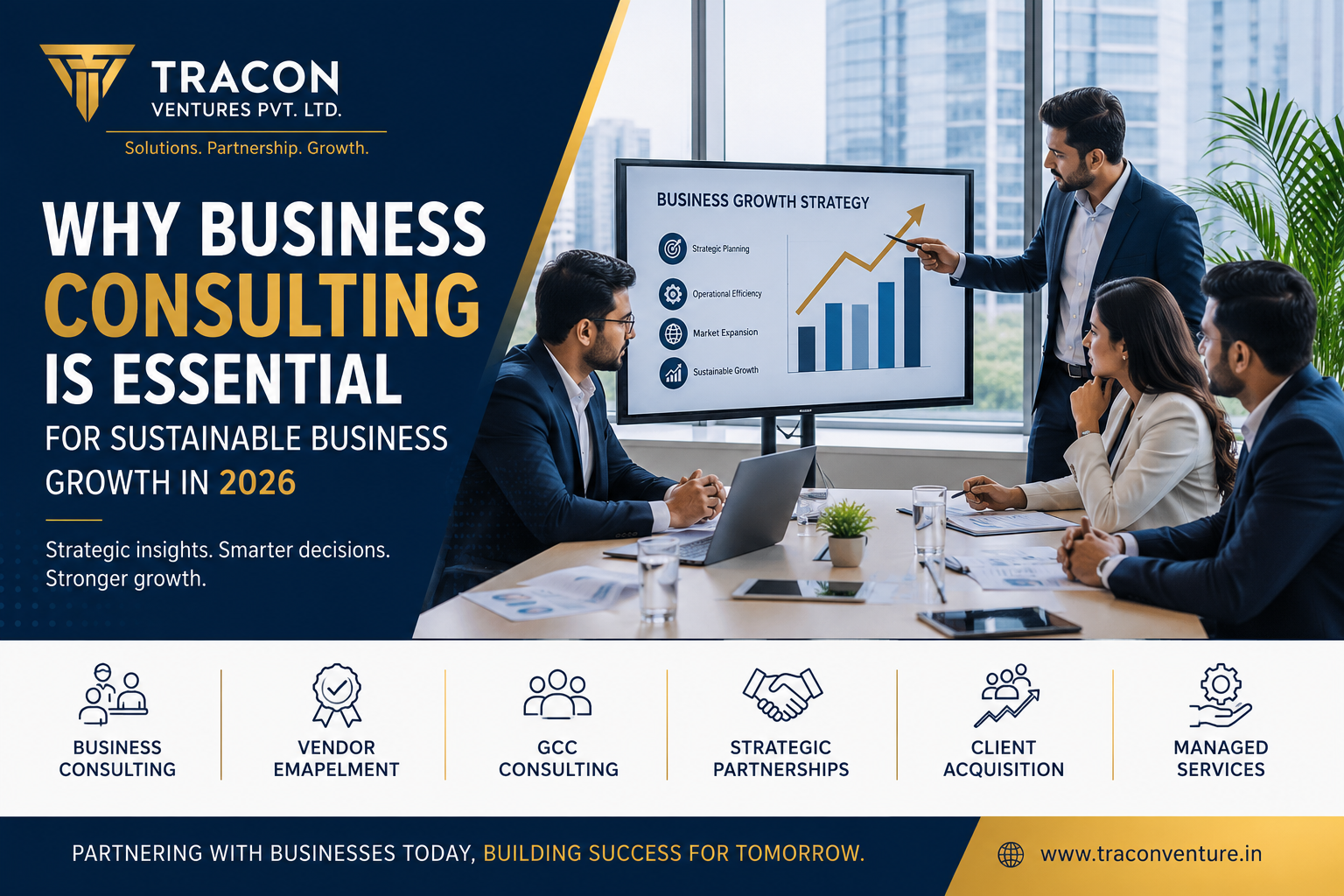
Why Business Consulting is Essential for Sustainable Business Growth in 2026

12 July 2026 Consulting Tracon Ventures

Why Business Consulting is Essential for Sustainable Business Growth in 2026

Business growth in 2026 is no longer only about increasing sales. Companies are expected to grow while improving efficiency, managing risk, adopting technology, building stronger partnerships and responding quickly to changing market conditions.This is where business consulting becomes increasingly important.Professional business consulting helps organizations understand where they currently stand, identify realistic growth opportunities and create structured strategies for long-term development. For businesses facing expansion decisions, operational challenges or competitive pressure, the right consulting partner can provide valuable external perspective and practical direction.Tracon Ventures supports businesses through strategic consulting, vendor empanelment support, GCC expansion, strategic partnership development, client acquisition support, technology trading and operational coordination.

What Is Business Consulting?

Business consulting is a professional advisory service that helps organizations solve business challenges, identify opportunities and improve decision-making.A business consultant typically evaluates different areas of an organization, such as:

  • Business strategy
  • Operational processes
  • Market opportunities
  • Commercial challenges
  • Vendor relationships
  • Partnership opportunities
  • Client acquisition
  • Expansion plans
  • Technology requirements

The objective is to help management teams make informed decisions and create practical plans that can be implemented effectively.Business consulting is especially valuable when companies are entering new markets, restructuring operations, exploring partnerships or planning significant growth.

Why Business Consulting Matters More in 2026

Business environments are becoming increasingly complex.Organizations must respond to changes in customer expectations, technology, competition, regulations and global market conditions.Decisions that previously relied mainly on internal experience may now require broader market understanding and strategic analysis.Business consulting can help companies evaluate these changes from an independent perspective.Some of the major reasons consulting is becoming more important include:

  • Faster technological transformation
  • Increasing market competition
  • Global expansion opportunities
  • Complex vendor ecosystems
  • Growing need for operational efficiency
  • Greater focus on strategic partnerships
  • Increasing importance of data-driven decisions

Professional consulting helps businesses understand how these factors affect their specific organization.

Business Consulting Helps Create a Clear Growth Strategy

One of the biggest challenges for growing businesses is determining where to focus resources.Companies may have several opportunities but limited time, capital and management capacity.A structured growth strategy helps organizations prioritize the opportunities that offer the greatest potential.Business consultants can help management teams answer questions such as:

  • Which markets should we enter?
  • Which customer segments should we target?
  • Which partnerships can accelerate growth?
  • Which services should we expand?
  • Where are operational improvements required?
  • Which opportunities offer sustainable long-term value?

A clear strategy provides direction and helps different departments work toward common objectives.

Sustainable Growth Requires Strong Operations

Rapid growth without strong operational systems can create serious problems.Businesses may experience:

  • Higher operating costs
  • Delayed projects
  • Poor coordination
  • Customer service challenges
  • Vendor management issues
  • Difficulty managing larger teams

Business consulting can help organizations identify operational weaknesses before they become major problems. Consultants may review existing workflows, communication systems and operational processes to identify areas for improvement.The objective is not simply to reduce costs but to create systems capable of supporting future growth.

Business Consulting Improves Decision-Making

Business leaders make decisions every day that can significantly affect company performance.These decisions may involve:

  • Expansion
  • Hiring
  • Technology investments
  • Vendor selection
  • Strategic partnerships
  • Product development
  • Market entry
  • Pricing
  • Distribution

Professional consulting provides an additional layer of analysis before major decisions are made.External consultants can help evaluate available information, identify risks and provide alternative perspectives.This allows management teams to make better-informed decisions based on both internal knowledge and external strategic insight.

Business Consulting Supports Market Expansion

Expanding into a new market can create significant growth opportunities.However, market expansion also involves uncertainty.Businesses must understand local competition, customer behavior, vendors, regulations and potential partners.Business consultants can help organizations develop a structured market-entry strategy.This may include:

  • Market opportunity assessment
  • Competitor analysis
  • Local partnership identification
  • Vendor evaluation
  • Commercial coordination
  • Operational planning

Tracon Ventures helps businesses evaluate expansion opportunities and develop practical strategies for entering new markets.

Vendor Empanelment Can Create New Business Opportunities

Vendor empanelment can help companies access larger organizations and institutional buyers.Many corporations, government organizations and large enterprises maintain approved vendor networks.Being included in these networks may create valuable commercial opportunities.However, the vendor empanelment process can require:

  • Documentation
  • Compliance verification
  • Company information
  • Financial details
  • Technical capability information
  • Commercial coordination

Tracon Ventures provides vendor empanelment support to help businesses better understand and manage these processes.A structured vendor strategy can help companies build long-term relationships with larger organizations.

GCC Consulting Supports Global Business Expansion

Global Capability Centers are becoming an important component of international business strategy.Companies establish GCCs to access specialized talent, improve operational efficiency and support global business functions.However, setting up or expanding a GCC involves several strategic and operational decisions.These may include:

  • Location planning
  • Vendor selection
  • Infrastructure coordination
  • Talent requirements
  • Technology integration
  • Operational setup
  • Partnership development

Tracon Ventures provides GCC consulting and expansion support to help organizations navigate these requirements. Effective GCC planning can help organizations create scalable operations while maintaining cost efficiency and operational control.

Strategic Partnerships Can Accelerate Business Growth

Strategic partnerships allow businesses to combine resources, capabilities and market access.The right partnership can help a company:

  • Enter new markets
  • Access new customers
  • Introduce new technologies
  • Expand distribution
  • Improve service capabilities
  • Reduce market-entry risk

However, successful partnerships require alignment between both organizations.Business consultants can help companies identify suitable partners and evaluate potential collaboration opportunities.Tracon Ventures supports organizations through strategic partnership development, helping businesses build relationships that create mutual commercial value.

Client Acquisition Requires a Structured Approach

Client acquisition remains one of the most important challenges for growing companies.Businesses often depend heavily on referrals or informal networking.While these methods can generate opportunities, they may not create a predictable growth pipeline.A structured client acquisition strategy may include:

  • Target market identification
  • Business networking
  • Lead opportunity development
  • Commercial introductions
  • Partnership-based referrals
  • Market outreach
  • Relationship management

Tracon Ventures provides client acquisition support designed to help organizations expand their business networks and identify relevant opportunities.

Technology Is Transforming Business Consulting

Technology plays an increasingly important role in business strategy.Modern organizations rely on software, automation and digital platforms to improve productivity and customer experience.However, selecting the right technology requires careful evaluation.Businesses must consider:

  • Implementation costs
  • Integration requirements
  • Vendor reliability
  • Employee adoption
  • Scalability
  • Long-term support

Business consultants can help companies evaluate technology options based on business requirements rather than simply following market trends.Tracon Ventures also supports businesses through technology trading and distribution facilitation, helping connect organizations with suitable technology products and commercial partners.

Business Consulting Helps Organizations Manage Risk

Every growth opportunity involves some level of risk.Entering a new market, signing a strategic partnership or investing in new technology can create financial and operational uncertainty.Consulting helps businesses identify potential risks before major commitments are made.Risk assessment may include:

  • Market risk
  • Operational risk
  • Vendor risk
  • Partnership risk
  • Financial risk
  • Technology risk
  • Execution risk

Understanding these risks allows organizations to develop contingency plans and make more informed decisions.

External Perspective Can Reveal Hidden Opportunities

Internal teams often become deeply involved in daily operations.This can make it difficult to identify certain inefficiencies or opportunities.External consultants bring a different perspective.They may identify:

  • Underserved customer segments
  • New partnership opportunities
  • Operational improvements
  • Alternative distribution channels
  • Technology opportunities
  • New markets

This outside perspective can help businesses discover opportunities that might otherwise remain unnoticed.

Business Consulting Helps Build Long-Term Competitive Advantage

Competitive advantage is not created by one successful decision.It develops through continuous improvement.Organizations must consistently improve:

  • Processes
  • Customer experience
  • Technology
  • Partnerships
  • Market positioning
  • Operational efficiency

Business consulting helps companies evaluate these areas and develop improvement strategies.Over time, these improvements can create stronger business capabilities and make the organization more competitive.

Who Should Consider Business Consulting Services?

Business consulting can benefit organizations at different stages of growth.It can be particularly useful for:

  • Startups preparing for expansion
  • Small and medium-sized businesses
  • Established companies entering new markets
  • Companies seeking strategic partnerships
  • Organizations pursuing vendor empanelment
  • Businesses exploring GCC opportunities
  • Technology providers seeking distribution partnerships
  • Companies improving operational efficiency

The consulting approach should always be customized according to the organization’s specific objectives.

How Tracon Ventures Supports Business Growth

Tracon Ventures provides strategic business support across several areas.Key services include:

  • Business Consulting & Advisory
  • Vendor Empanelment Support
  • GCC Consulting & Expansion
  • Strategic Partnership Development
  • Managed Services Facilitation
  • Client Acquisition Support
  • Technology Trading & Distribution
  • Operational Coordination & Commercial Support

The objective is to help organizations combine strategy with practical execution.Rather than providing generic recommendations, Tracon Ventures focuses on understanding business requirements and identifying realistic opportunities for growth.

Why Sustainable Business Growth Requires Strategy

Sustainable business growth means creating long-term value rather than focusing only on short-term revenue.Companies that grow sustainably typically have:

  • Clear business strategies
  • Strong operational systems
  • Reliable partners
  • Effective leadership
  • Efficient technology
  • Strong customer relationships
  • Adaptability

Professional business consulting can help organizations strengthen these areas and prepare for future opportunities.

Conclusion

Business consulting is becoming increasingly important as organizations navigate a more competitive and rapidly changing business environment.In 2026, companies must balance growth with operational efficiency, technology adoption, strategic partnerships and risk management.Professional business consulting services can help organizations create structured growth strategies, improve decision-making and identify new opportunities.Tracon Ventures supports businesses through consulting, vendor empanelment, GCC expansion, partnership development, client acquisition, technology distribution and operational coordination.For organizations planning their next stage of growth, the right consulting support can help turn business opportunities into practical, sustainable results.

Connect with Tracon Ventures to discuss your business growth, expansion and strategic consulting requirements.

TV

Tracon Ventures

Business consulting and strategic support focused on helping organizations build stronger partnerships, improve operations and identify sustainable growth opportunities.

Strategy • Insight • Impact

Turn Business Insights Into Practical Action

Connect with Tracon Ventures for business consulting, vendor empanelment, GCC expansion, strategic partnership development and operational support.